



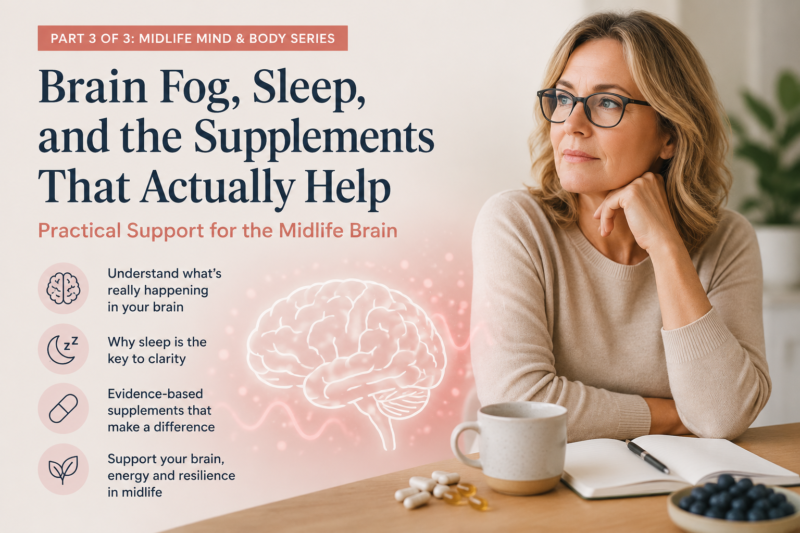
PART 3 OF 3: MIDLIFE MIND & BODY SERIES
By Suzi Jenner • Coach, Counsellor & Hypnotherapist
Quick Summary
Brain fog during perimenopause is a real neurological event, not a sign of cognitive decline. It’s driven by hormonal fluctuations that affect brain energy, blood flow, and neurotransmitter function — and it’s made significantly worse by disrupted sleep. This article explains what’s actually happening in your brain, why sleep is the linchpin, and which evidence-based supplements — including creatine, magnesium, omega-3s, and vitamin D — can support clarity, energy, and resilience during this transition.
What brain fog actually is – and what it isn’t
Let’s name the fear that sits behind brain fog for most women: Am I losing my mind?
You walk into a room and can’t remember why. You reach for a word you’ve used a thousand times, and it’s simply not there. You lose your train of thought mid-sentence. You read a paragraph and realise at the bottom that you absorbed nothing. It’s not occasional forgetfulness — it’s a persistent haze that makes you question your own competence.
Here’s what the research tells us: brain fog during perimenopause is common, affecting over 60 percent of women during the hormonal transition. It’s driven by fluctuating oestrogen, which directly affects how the brain produces energy, how blood flows through it, and how neurotransmitters like serotonin and acetylcholine function. When oestrogen levels swing, the brain’s energy metabolism becomes less efficient. Brain regions involved in memory, attention, and word retrieval — particularly the hippocampus and prefrontal cortex — receive less stable hormonal support.
But here is the reassuring part, and it matters: research by Dr Lisa Mosconi, a neuroscientist who has studied the menopausal brain extensively, shows that these changes appear to be temporary. The brain adjusts. Women may feel tired and foggy, but cognitive performance — actual measurable sharpness — does not decline. Your brain is in transition, not in deterioration. You are still as capable as you ever were, even on the days it doesn’t feel that way.
Brain fog is not early dementia. It is not a sign that something is permanently wrong. And it is not a reason to doubt your professional competence, however tempting that is at 2pm on a Wednesday when you’ve forgotten your own password for the third time.
Why sleep is the linchpin
If brain fog is the symptom women notice most, sleep disruption is the one that drives the most damage beneath the surface.
As we explored in Part 2, shifting oestrogen and progesterone levels directly interfere with sleep architecture. But for many women in perimenopause, the sleep disruption isn’t just about falling asleep or staying asleep in the abstract. It’s about night sweats.
Hot flushes during sleep can be relentless. Body temperature fluctuates wildly — blankets on, blankets off, all night long. You wake soaked. You strip the covers. Ten minutes later you’re freezing. By morning you feel like a wrung-out rag, and yet the day still expects you to show up, perform, make decisions, be patient with your children, and function as though you slept. Night after night, week after week.
This matters beyond just feeling tired. During deep sleep, the brain activates its glymphatic system — a network of pathways that flushes out metabolic waste, including proteins linked to cognitive decline. When deep sleep is fragmented or shortened, that cleaning process is compromised. Over time, chronic sleep disruption worsens inflammation, increases cortisol, impairs glucose metabolism in the brain, and accelerates the very fog and fatigue you’re already experiencing.
Sleep is not a luxury during this transition. It is the single most protective thing for your brain, your mood, your hormonal balance, and your metabolic health. Everything else — nutrition, supplementation, stress management — works better when sleep is addressed first.
If night sweats are the primary disruption, this is exactly the kind of symptom a hormone-literate practitioner can help with. There are targeted interventions — from hormonal support to practical environmental strategies — that can make a real difference. This is not something you should simply endure.
Supplements that have earned their place
There is a lot of noise in the supplement space — extravagant promises, expensive formulations, and very little evidence behind most of them. What follows are four supplements that have credible research supporting their use during midlife, particularly for brain function, energy, and resilience under stress. None of them is a replacement for hormonal support, good sleep, or adequate nutrition. All of them can make a meaningful difference as part of a broader picture.
Always consult your healthcare practitioner before starting any new supplement, especially if you take medication.
Creatine — not just for the gym
If you think of creatine as a bodybuilding supplement, you’re not alone. That’s been the reputation for decades. But recent research has shifted the focus squarely to the brain, and the findings are striking.
Your brain consumes enormous amounts of energy. It makes its own creatine, and it uses it to regenerate ATP — the molecule that powers every cellular process. Under normal conditions, the brain makes enough. But under stress — sleep deprivation, cognitive overload, emotional strain, depression — demand outstrips supply. That’s when supplemental creatine becomes interesting.
Studies have shown that creatine supplementation can negate the cognitive deficits caused by sleep deprivation. In one study, participants who were kept awake for 21 hours and given creatine not only avoided the expected cognitive decline — they performed better than well-rested participants who hadn’t supplemented. Other research has found that creatine, alongside cognitive behavioural therapy, produced greater improvements in depressive symptoms than therapy alone.
Research from Germany found that at 5 grammes per day, creatine is largely consumed by muscle. At 10 grammes per day, the surplus crosses into the brain and measurably increases creatine levels in multiple brain regions. This is why many researchers now recommend higher doses for cognitive benefit.
Speaking personally, creatine has made a noticeable difference to my clarity of thinking. The mid-afternoon fog that used to descend like clockwork has lifted. I can’t separate the effect from other things I’m doing — and I’m honest about the possibility of a placebo — but the research supports what I’m experiencing, and that’s enough for me to keep going with it. It’s also supporting my muscle development and recovery, which matters increasingly as we age.
Magnesium — the mineral most of us are missing
Nearly half the population doesn’t get adequate magnesium, and the consequences are widespread. Magnesium is required for over 300 enzymatic processes in the body, including energy production, DNA repair, nervous system function, and muscle relaxation. It plays a direct role in sleep quality, mood regulation, and stress resilience.
During perimenopause, magnesium becomes particularly important because of its relationship with cortisol. Magnesium helps regulate the stress response — when levels are low, cortisol runs higher and longer. It also supports the production of serotonin and melatonin, both of which influence mood and sleep. Studies have shown that people with the highest magnesium levels have significantly lower all-cause mortality — a 40 percent reduction in one large study.
Magnesium glycinate is generally recommended for sleep and mood support because of its superior absorption and calming properties. A daily dose of 200 to 400 milligrammes, taken in the evening, is a reasonable starting point.
Omega-3 fatty acids — the inflammation dampener
Omega-3 fatty acids — EPA and DHA, found in fatty fish and fish oil supplements — are among the most well-researched nutrients for brain health and longevity. They reduce inflammation, support neurotransmitter function, and improve blood flow to the brain.
For women in perimenopause, this matters because neuroinflammation is emerging as a significant contributor to brain fog, mood disturbance, and cognitive change. Omega-3s also support cardiovascular health, which is directly relevant as oestrogen’s protective effect on the heart diminishes during this transition.
Research has found that a high omega-3 index — a measure of omega-3 levels in red blood cells — is associated with a five-year increase in life expectancy. One study found that having a low omega-3 index carried a mortality risk comparable to smoking. This isn’t fringe science — it’s large-scale, well-designed research that consistently points in the same direction.
One to two grammes of fish oil per day can shift the omega-3 index from low to high within a few months. If you eat fatty fish like salmon two to three times a week, you may already be well-covered.
Vitamin D — more hormone than vitamin
Vitamin D is technically a hormone precursor, not a vitamin. It’s made in the skin from sunlight, and it regulates over five percent of the human genome. It plays critical roles in mood, immunity, bone health, and brain function – and around 70 percent of the population has insufficient levels.
Vitamin D deficiency has been associated with an 80 percent increase in dementia risk. Conversely, supplementation has been shown to reduce dementia risk by 40 percent in people who were previously deficient. It also has a direct effect on mood — low vitamin D is consistently linked to depression and low energy, both of which are common during perimenopause.
If you live in a climate with limited sun exposure — which includes much of Australia’s southern states during winter — supplementation is worth discussing with your practitioner. A blood test can establish your baseline. Most adults with a deficiency can reach optimal levels with around 4,000 IU per day, though individual needs vary.
The bigger picture: foundations first
Supplements are not the headline. They’re the supporting cast. The headline is this: your brain is going through a transition, and it needs more support than it used to. That support starts with sleep, extends to stress management and hormonal investigation, and is rounded out by ensuring your body has the nutritional resources it needs to function under increased demand.
No supplement will override chronic sleep deprivation, unaddressed hormonal imbalance, or an unsustainable pace of life. But when the foundations are in place — or at least moving in the right direction — the right supplements can provide a meaningful edge. They can be the difference between a functional day and a foggy one.
If this series has resonated with you, the most important thing you can do is take the first step we outlined in Part 1: find a practitioner who understands women’s hormonal health, bring your symptom journal, and have the conversation. You deserve support that sees the whole picture — the hormones, the stress, the sleep, the brain, and the capable woman in the middle of all of it who is not broken, not failing, and not imagining things.
She’s in transition. And with the right support, she’ll come through it.
This article is for general information only and is not a substitute for professional medical advice. If you are concerned about your physical or mental health, please consult a qualified healthcare practitioner.
You don’t have to manage it alone.
Book a session to explore your situation and start working on tools that fit your life.