



PART 2 OF 3: MIDLIFE MIND & BODY SERIES
By Suzi Jenner • Coach, Counsellor & Hypnotherapist
Quick Summary
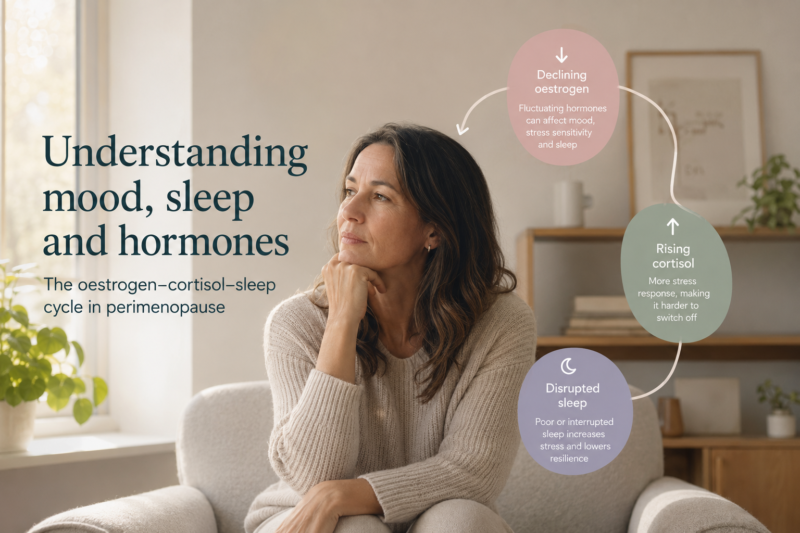
During perimenopause, declining oestrogen weakens the body’s ability to regulate cortisol — the main stress hormone. At the same time, elevated cortisol suppresses oestrogen and competes with progesterone. The result is a feedback loop: hormonal changes make stress feel harder, and stress makes hormonal symptoms worse.
Same life, different capacity
Two years ago you were handling the same job, the same household, the same children, and the same partner. Nothing external has changed in any dramatic way. And yet everything feels harder. The patience you could draw on at 5pm has run out by noon. Tasks that used to take an hour take two because your brain keeps losing the thread. You’re doing less, but it costs more.
If you’ve mentioned this to anyone, you’ve probably heard some version of “You’re just stressed” or “Welcome to your 40s.” And maybe you’ve accepted that framing because it’s the only one on offer. But it doesn’t explain why the same stress that you carried comfortably before now feels like it’s crushing you.
This isn’t a mindset problem. It’s a physiology problem. And once you see the mechanics of it, the self-blame starts to loosen.
Oestrogen’s hidden job: the stress brake
Most women know oestrogen in terms of reproduction – cycles, fertility, and menopause. But oestrogen has a second, less well-known role that directly affects how you experience daily life: it helps regulate your stress response.
Oestrogen influences how the hypothalamic-pituitary-adrenal axis — the body’s central stress system — responds to pressure. In practical terms, it acts as a brake on cortisol production. When oestrogen levels are stable, cortisol rises in response to a stressor and then comes back down in an orderly way. The system fires, does its job, and resets.
During perimenopause, oestrogen doesn’t simply decline. It fluctuates unpredictably, sometimes wildly, from week to week. When oestrogen dips, the brake on cortisol weakens. Cortisol rises higher, stays elevated longer, and doesn’t reset as cleanly. Research from Vanderbilt University has found that oestrogen fluctuation during perimenopause is directly associated with increased sensitivity to psychosocial stress and greater vulnerability to low mood.
This means the same stressor — a difficult meeting, a child’s meltdown, a broken appliance on a Tuesday — now produces a bigger cortisol response than it would have two years ago. Not because you’re weaker. Because the regulatory system that used to modulate your response is running on an unreliable signal.
You might notice this as a disproportionate emotional reaction. Something small happens — a colleague’s offhand comment, a traffic delay, your teenager leaving dishes in the sink again — and the anger or frustration that floods through you is out of all proportion to the event. Afterwards, you think, why did I react like that? The answer is cortisol, arriving faster and staying longer than your pre-perimenopausal brain would have allowed.
Cortisol fights back: the hormonal tug of war
Here’s where the loop closes. Elevated cortisol doesn’t just sit there passively. It actively interferes with the hormones that are already shifting.
Cortisol can reduce oestrogen receptor sensitivity, making your cells less responsive to the oestrogen you do still produce. So even when oestrogen levels are adequate, the signal doesn’t land properly. The result is that hormonal symptoms – mood swings, brain fog, and hot flushes – can worsen even without further oestrogen decline.
Progesterone gets caught in the crossfire too. Cortisol and progesterone share a biochemical pathway — they’re both made from the same precursor, pregnenolone. When the body is under chronic stress, it prioritises cortisol production over progesterone. This is sometimes called the “pregnenolone steal”. The body, in survival mode, diverts resources towards the stress response and away from the calming, sleep-supporting hormone that you need more than ever.
Progesterone is often called the calming hormone for good reason. It supports sleep, reduces anxiety, and helps stabilise mood. When it’s depleted by chronic cortisol demand, sleep quality drops, anxiety rises, and emotional regulation becomes harder. All of which feel a lot like burnout. And here’s the part that makes it genuinely disorienting: because cortisol is suppressing your sensitivity to oestrogen while simultaneously stealing from your progesterone supply, your hormonal symptoms can worsen during periods of high stress even when your actual hormone levels haven’t changed. This is why stressful weeks often come with worse brain fog, worse sleep, and worse mood — the stress isn’t just adding to the load; it’s actively undermining the hormonal resources you need to manage the load.
The sleep-stress spiral
Sleep sits right at the centre of this loop, and it’s usually the first thing to break.
Shifting oestrogen and progesterone levels directly disrupt sleep architecture. Many women in perimenopause begin waking between 2am and 3am, long before they experience any other obvious hormonal symptoms. Elevated cortisol at night — when it should be at its lowest — keeps the brain alert when it’s trying to wind down.
Poor sleep then increases cortisol the following day. Higher daytime cortisol increases stress sensitivity, reduces patience and cognitive clarity, and makes it harder to fall asleep the following night. The spiral tightens with each turn.
It’s worth pausing on what this actually feels like in daily life. You drag through the morning, relying on caffeine to function. By mid-afternoon you’re running on fumes, and everything anyone asks of you feels like an imposition. You snap. You apologise. You lie awake that night going over what you said and what you should have said, and the cortisol from that mental replay keeps you alert when you desperately need to be asleep. By morning you’re starting the same cycle one rung lower down the ladder.
There’s a metabolic dimension too. Sleep deprivation worsens insulin resistance, which is already beginning to develop during perimenopause as oestrogen declines. Insulin resistance increases inflammation. Inflammation drives further hormonal disruption. The body is fighting on multiple fronts — and every front makes the others worse.
If this sounds like a system designed to fail, it’s not. It’s a system designed for a world where stress was acute and temporary — a predator, a famine, a short-term crisis. It was never designed for the sustained, low-grade, unrelenting stress of modern midlife: the emails, the school logistics, the ageing parent’s medical appointments, the performance review, the meal planning, and the emotional labour, day after day, without a recovery window.
Why your body isn’t betraying you
When you understand the loop, something important shifts. You stop looking at yourself as the problem and start seeing a set of interacting systems that need different conditions to function well.
Your body isn’t betraying you. It’s responding exactly as it’s designed to respond when hormonal signals are unstable and stress recovery is inadequate. The irritability isn’t a character flaw. The brain fog isn’t early dementia. The exhaustion isn’t laziness. These are downstream effects of a physiological feedback loop that has a name and a mechanism.
And the mechanism points towards solutions. If oestrogen instability weakens cortisol regulation, supporting hormonal balance becomes a stress-management strategy, not just a reproductive health issue. If chronic cortisol suppresses progesterone, then stress reduction isn’t optional — it’s hormonal medicine. If sleep disruption drives the loop, then protecting sleep is foundational, not a nice-to-have.
The loop also explains why isolated interventions often don’t work. A meditation app won’t resolve an oestrogen deficit. An oestrogen patch won’t fix an unsustainable workload. A sleep supplement won’t reset cortisol patterns that are being driven by both hormonal instability and life stress. The women who get the best outcomes tend to be the ones who address both sides — the hormonal and the structural — at the same time.
This is also why well-meaning advice can feel so hollow during this phase. “Just take a bath.” “Have you tried yoga?” “You need to set better boundaries.” None of those suggestions are wrong, exactly. But when they’re offered as a complete solution to a woman whose cortisol regulation has been destabilised by hormonal fluctuations she doesn’t even know she’s having, they miss the point. The issue isn’t a lack of self-care. It’s a system under pressure from the inside and the outside simultaneously.
What you can do with this understanding
Knowledge of the loop doesn’t fix the loop. But it changes three things that matter.
It changes the story. Instead of “I should be able to handle this”, the story becomes, “My physiology has shifted, and I need different support.” That’s not a weakness. It’s an accurate reading of your situation.
It changes the priority. Sleep, stress reduction, and hormonal investigation stop being things you’ll get to when things calm down. They become the things that make things calm down.
It changes who you ask for help. A practitioner who understands the interplay between cortisol, oestrogen, progesterone, and insulin resistance can assess and support you as a whole system — not as a collection of isolated symptoms. As we covered in Part 1, a menopause-trained specialist is often essential here, because this is not generalist territory.
In Part 3, we’ll get practical. We’ll look at what brain fog actually is, why sleep is the linchpin of the whole system, and the evidence-based support – including specific supplements – that can genuinely help.
| This is Part 2 of a three-part series. Part 1: Perimenopause, Burnout, or Both? Why Women in Their 40s Can Feel Emotionally Different Part 3: Brain Fog, Sleep, and the Supplements That Actually Help |
This article is for general information only and is not a substitute for professional medical advice. If you are concerned about your physical or mental health, please consult a qualified healthcare practitioner.
You don’t have to manage it alone.
Book a session to explore your situation and start working on tools that fit your life.