


Learn why stress builds up quietly and how to recognise the early signs before overwhelm takes over.
Some days you can manage everything. The noise, the questions, the messages, the mess in the kitchen, the pressure, and the constant demands all add up. And then one day, something tiny happens:
- someone asks you one more question
- your child spills water
- a message arrives at the wrong moment
- somebody says something completely ordinary
…and suddenly you feel like you might explode.
Afterwards many women think:
“Why did I react so strongly? It was such a small thing.”
But usually, it’s not about the small thing.
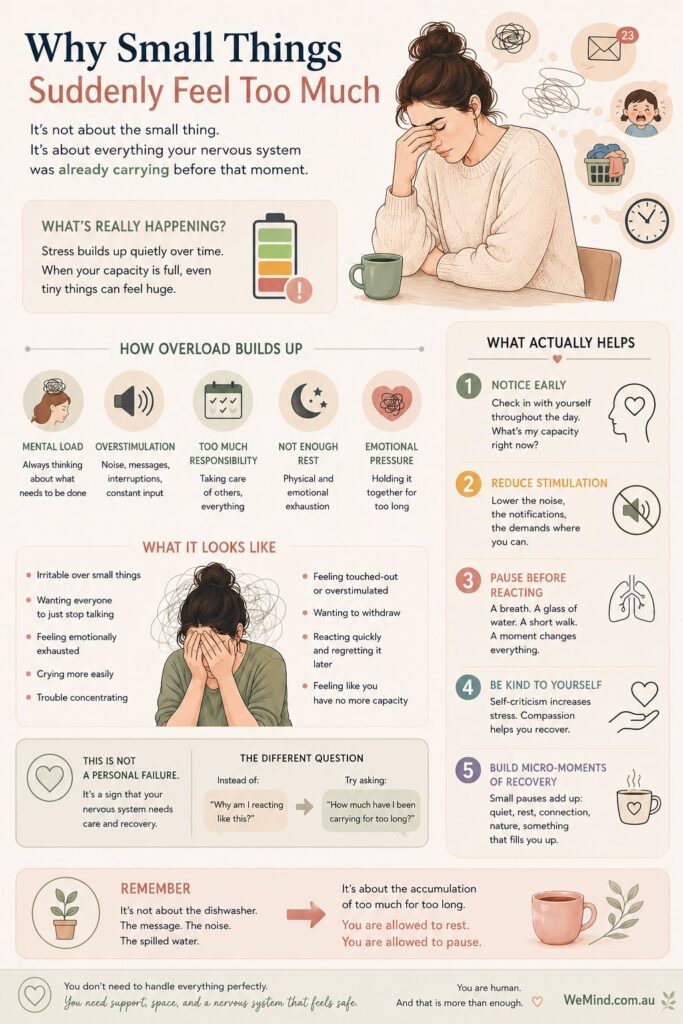
It’s about everything your nervous system was already carrying before that moment.
Emotional Overload Often Builds Quietly
Stress does not always arrive dramatically.
More often, it accumulates slowly:
- mental load
- lack of rest
- emotional pressure
- overstimulation
- constant responsibility
- not enough time alone
- too many decisions
- trying to hold everything together
Many women stay functional for a long time while emotionally overloaded.
They keep going because they have to.
Until something small becomes “the last drop.”
Your Nervous System Has Limits
We often expect ourselves to stay patient, calm, emotionally available, productive, and organised all the time.
But the nervous system is not unlimited.
When stress builds for too long:
- patience decreases
- emotions become more reactive
- small frustrations feel bigger
- thinking becomes less flexible
- recovery takes longer
This is not weakness.
It’s a sign that your internal resources are running low.
Why We React More Strongly Under Stress
When the nervous system feels overloaded, the brain starts focusing more on survival and protection.
That means:
- less emotional capacity
- quicker reactions
- more irritability
- more sensitivity to noise, demands, interruptions, and conflict
This is why sometimes:
- one message feels overwhelming
- one comment hurts deeply
- one more request feels impossible
Even if on another day, the same thing would not bother you at all.
Common Signs of Emotional Overload
Many women notice:
- feeling irritated by small things
- wanting everyone to “just stop talking”
- emotional exhaustion
- crying more easily
- trouble concentrating
- feeling touched-out or overstimulated
- wanting to withdraw
- reacting quickly and regretting it later
These are often signs that your nervous system needs recovery, not criticism.
What Actually Helps
Not everything can be fixed immediately.
But small things help more than people realise.
1. Notice the build-up earlier
Many people only notice stress when they’re already overwhelmed.
Try asking yourself earlier:
- “What is my capacity today?”
- “What has my nervous system already been dealing with?”
2. Reduce stimulation where possible
Sometimes the nervous system simply needs less input:
- less noise
- fewer notifications
- fewer decisions
- fewer conversations for a moment
3. Pause before reacting
Even a short pause changes things.
A breath.
Walking away for one minute.
Not replying immediately.
Small pauses prevent bigger reactions.
4. Stop speaking to yourself harshly
Many women respond to overload with self-criticism:
- “I’m overreacting”
- “What’s wrong with me?”
- “I should handle this better”
But shame usually increases emotional stress instead of reducing it.
You Do Not Need to Earn Rest
A lot of women only allow themselves rest after everything is done.
But emotional recovery cannot always wait until the end.
Your nervous system needs small moments of recovery throughout the day:
- quiet
- slowing down
- breathing
- space
- support
Final Thoughts
Usually it’s not about the dishwasher, the message, the noise, or the spilt water.
Those moments simply reveal how overloaded the system already was.
Sometimes the most helpful question is not:
“Why am I reacting like this?”
But:
“How much have I been carrying for too long?”
And often, that question changes the conversation completely.