


Learn how to regulate emotions using the STOP technique. A simple, practical tool to pause, reset, and respond calmly in stressful situations.
When Emotions Take Over
You probably recognise this moment:
- you’re about to snap at your child or partner
- you reply to a message and immediately regret it
- anxiety builds before a conversation
- your body feels tense, your thoughts speed up
And afterwards, the same question comes up: “Why did I react like that?”
This is a common experience, especially for women managing multiple roles, responsibilities, and emotional demands.
In these moments, emotional regulation becomes essential.
Not about suppressing what you feel —
but about learning how to pause before reacting.
What Is Emotional Regulation?
Emotional regulation is the ability to:
- recognise your emotional state
- pause instead of reacting automatically
- choose a response that reflects your values and intentions
It doesn’t mean being calm all the time.
It means having more control over how you respond under stress.
For many women, this is not something that was explicitly taught — it’s a skill that develops over time with awareness and practice.
Why Emotional Regulation Matters
Without emotional regulation:
- stress builds up quickly
- communication breaks down
- reactions become impulsive
- relationships are affected
With stronger emotional regulation skills:
- you respond more calmly
- you feel more in control
- you recover faster from stress
- your relationships become more stable
This is especially important in:
- parenting
- partnerships
- workplace communication
- high-pressure situations
A Simple Tool: The STOP Technique
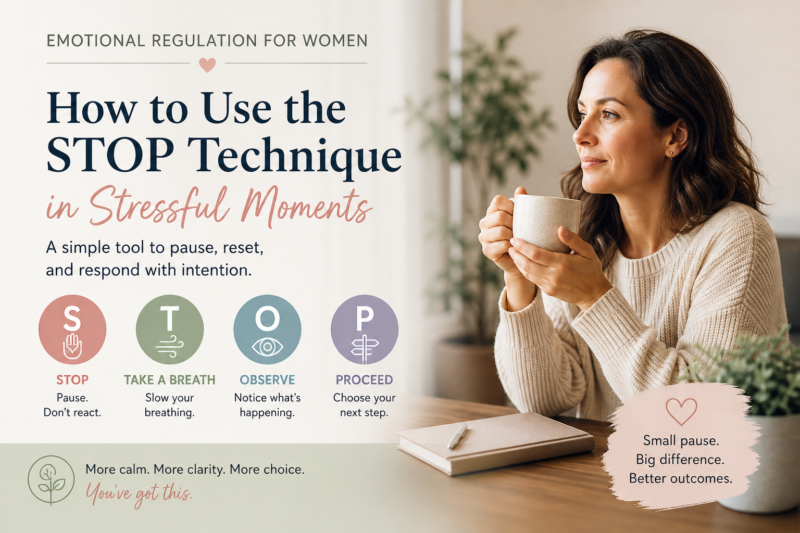
One of the most practical tools for managing emotional reactions is the STOP technique.
It’s widely used in mindfulness-based and cognitive-behavioural approaches to help interrupt automatic reactions and create a pause.
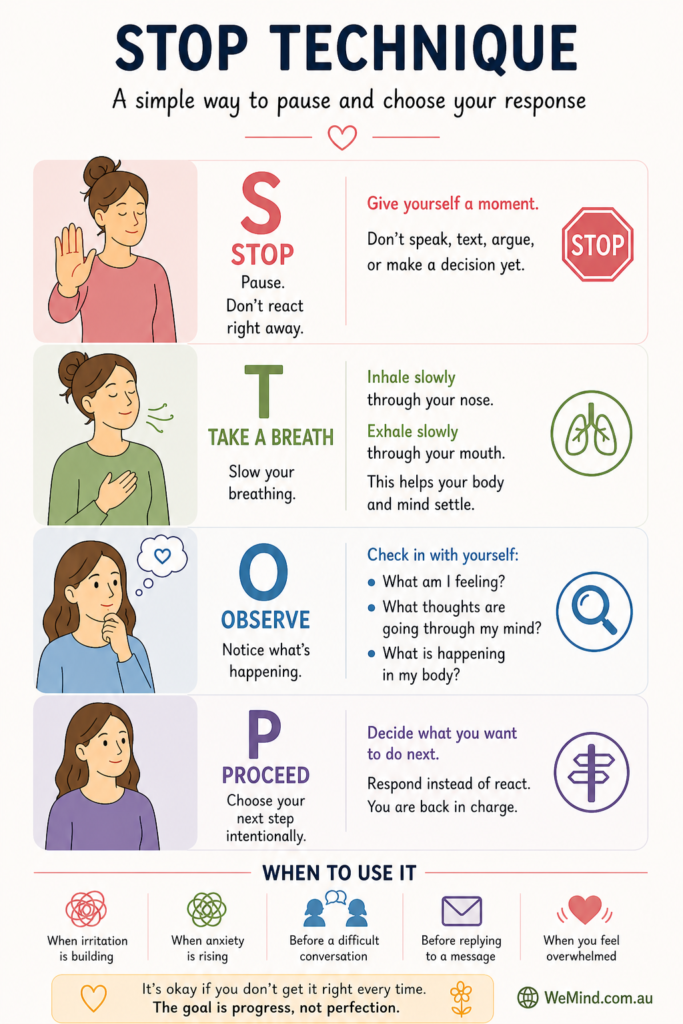
S — Stop
Pause.
Don’t respond immediately.
Don’t speak, text, argue, or make a decision yet.
Even a short pause interrupts the automatic emotional reaction.
T — Take a Breath
Slow your breathing.
Inhale through your nose, exhale slowly.
This helps regulate your nervous system and reduces emotional intensity.
O — Observe
Notice what is happening inside you:
- What am I feeling right now?
- What thoughts are going through my mind?
- What is happening in my body?
Try to observe without judging or analysing.
P — Proceed
Now choose your response intentionally.
You might:
- respond more calmly
- take a break from the situation
- say “I need a moment”
- decide not to engage at all
This is where awareness turns into action.
When to Use the STOP Technique
The STOP technique works best early, before emotions reach their peak.
Useful situations include:
- irritation starting to build
- anxiety before a difficult conversation
- feeling triggered in relationships
- parenting stress
- workplace pressure or conflict
The earlier you apply it, the more effective it becomes.
Why the STOP Technique Works
When emotions escalate quickly:
- your body enters a stress response
- your thinking becomes less flexible
- reactions become automatic and impulsive
The STOP technique helps to:
- interrupt the stress response
- re-engage the thinking part of the brain
- give your nervous system time to settle
In practical terms, it creates space between emotion and action — and that space changes outcomes.
Common Mistakes When Using STOP
1. Waiting too long
If emotional intensity is already very high, it’s harder to pause.
2. Expecting instant calm
The goal is not to feel completely calm.
The goal is to reduce intensity and slow things down.
3. Being self-critical
Thoughts like:
- “I shouldn’t feel this way”
- “I’m overreacting”
increase emotional pressure rather than helping.
A more effective approach is simple awareness.
Building Emotional Regulation Over Time
Emotional regulation is not a one-time technique — it’s a skill.
It improves through:
- repeated practice
- small moments of awareness
- learning from situations after they happen
You won’t always pause in time.
Sometimes you’ll react first and reflect later.
That’s part of the process.
What matters is gradually increasing the number of moments where you notice, pause, and choose.
Final Thought
You don’t need to eliminate emotions or always stay calm.
What makes a real difference is having tools that help you:
- slow down
- understand what’s happening inside you
- respond in a way that feels more aligned with who you want to be
The STOP technique is simple, but when used consistently, it can significantly improve how you handle stress, communication, and everyday challenges.
Need Support With Emotional Regulation?
If you notice that:
- emotions feel overwhelming
- you react quickly and regret it later
- stress, anxiety, or irritation are affecting your relationships
you don’t have to manage it alone.
I work with women to build practical emotional regulation skills, improve self-awareness, and create more stable, calm responses in everyday life.
You can book a session to explore your situation and start working on tools that fit your life.

Take the Next Step