



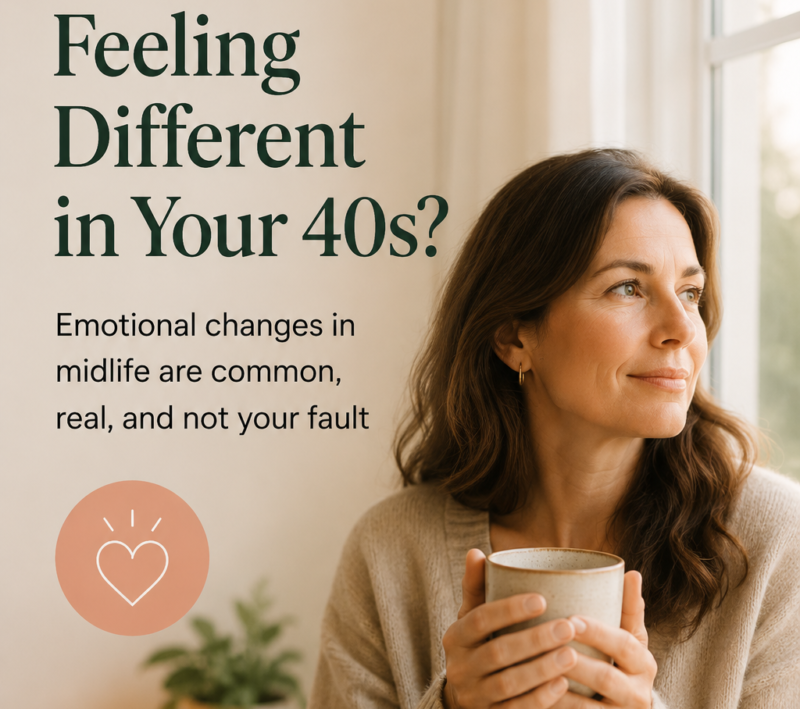
Why Women in Their 40s Can Feel Emotionally Different
Quick Summary
If you’re in your 40s and feeling emotionally different — more irritable, foggy, exhausted, or just not yourself — you’re not imagining it. Perimenopause and burnout share an almost identical set of symptoms: fatigue, brain fog, mood changes, sleep disruption, and a shorter emotional fuse. They can show up separately, but for many women they arrive together and make each other worse.
This article is not about diagnosis. It’s about pattern recognition — helping you see what might be driving what you’re feeling, so you can seek the right support sooner.
Read on for: the symptom overlap explained • what’s actually happening with your hormones • how to spot which thread is which • clear next steps.
“I just don’t feel like myself anymore”
That sentence comes up more than any other when women in their early 40s start to notice something has shifted. Not a dramatic event. Not a crisis. Just a quiet, persistent feeling that the person running your life isn’t quite the person you remember being.
Maybe you’re snapping at your partner over things that wouldn’t have bothered you a year ago. Maybe you walked into the kitchen and genuinely could not remember why. Maybe you’re lying awake at 2am with a mind that won’t switch off, then dragging yourself through the next day on fumes. Maybe you’re looking at your calendar — the same job, the same kids, and the same household — and thinking, I used to handle all of this. What’s wrong with me?
Nothing is wrong with you. But something may be changing — and it helps to understand what.
The question women usually land on is: Is this just stress? Is it my hormones? Am I burning out? Or is this something else entirely?
The honest answer, for a lot of women in their 40s, is that it’s more than one thing happening at once. And that overlap is exactly what makes it so confusing — and so easy to dismiss.
The symptoms that look the same from both directions
Here’s what makes this so tricky. Perimenopause — the hormonal transition that can begin years before your periods actually stop — and burnout — the state of chronic stress that has not been managed — produce a near-identical set of symptoms.
Fatigue that sleep doesn’t fix. Brain fog and difficulty finding words. Irritability and a shorter emotional fuse. Sleep disruption, especially waking between 2am and 3am. Mood swings or feeling emotionally flat. Loss of confidence and a pull to withdraw. Reduced motivation and a sense that your usual spark has gone.
If you drew a Venn diagram of perimenopause symptoms and burnout symptoms, the overlap would be almost a complete circle. Both affect your nervous system, your sleep patterns, your mental clarity, and your emotional resilience. Both can leave you feeling like a different person.
And here’s the part that really matters: they can coexist. A woman can be experiencing genuine hormonal shifts and genuine burnout at the same time, each making the other worse. If she’s only being assessed for one, the other gets missed — and the support she receives doesn’t land.
What’s actually happening with your hormones in your 40s
Perimenopause typically begins in the late 30s or early 40s and can span a decade before periods stop completely. But the word “perimenopause” often conjures images of hot flushes and night sweats – the dramatic end of the spectrum. The earlier phase is far more subtle.
What happens first is that oestrogen and progesterone begin to fluctuate unpredictably. Not just declining — swinging. It’s the instability that causes most of the trouble, not the drop itself. One week your oestrogen might spike; the next, it plummets. Your body and brain are constantly adjusting to a signal that keeps changing.
Oestrogen doesn’t just manage your reproductive system. It directly affects how your brain produces energy, how blood flows to the brain, how neurotransmitters like serotonin function, and how the emotional centres of your brain respond to stress. When oestrogen levels are unstable, the brain’s capacity to regulate mood, memory, and focus becomes unstable too.
That’s why brain fog during perimenopause isn’t a character flaw or a sign you’re losing your mind. It’s a real neurological event. Research shows that over 60% of women experience cognitive changes during this transition — difficulty concentrating, forgetting words mid-sentence, and walking into rooms with no memory of why. These changes appear to be temporary and, reassuringly, do not affect actual cognitive performance. Your brain is adjusting. You are still as sharp as you ever were.
Sleep disruption often has hormonal roots too. Waking at 2am or 3am is one of the earliest signals that hormone levels are shifting, even when cycles are still regular. And poor sleep, as anyone who has lived through it knows, makes everything else worse — mood, patience, focus, the ability to cope with a normal day.
Perhaps the most common description women give in this phase is, “I just don’t feel like myself.” A loss of confidence. Less interest in socialising. A feeling that the joy has dimmed. These aren’t personality changes — they’re symptoms. And they started appearing in the medical literature only recently, despite women reporting them for generations.
What burnout looks like — and why the timing is cruel
The World Health Organisation defines burnout as a state of chronic stress that has not been successfully managed. It shows up as three things: persistent exhaustion, growing detachment or cynicism about things you used to care about, and a reduced sense of effectiveness — feeling like you can’t do what you used to do as well as you used to do it.
Burnout isn’t just about working too hard. It’s about sustained demand without adequate recovery. And the timing, for women in their 40s, is genuinely cruel. This is often peak life load: career responsibility, children who need you in complex new ways, ageing parents who need you for the first time, a household that doesn’t run itself, and the invisible labour of making everything and everyone function. It’s a lot, even without a single hormone changing.
When burnout is the primary driver, cortisol — the body’s main stress hormone — stays elevated. That disrupts sleep, digestion, decision-making, and emotional regulation. It can feel remarkably like perimenopause. The difference is that burnout is a response to sustained external pressure, while perimenopause originates from internal hormonal shifts.
But in practice, the two rarely stay in their lanes.
How they make each other worse
This is the piece most women don’t hear, and it’s the one that can change how you understand what you’re going through.
Oestrogen normally helps regulate cortisol. It puts a brake on the stress response. When oestrogen levels become unstable during perimenopause, that brake weakens. Cortisol doesn’t just rise because life is more stressful — it rises because there’s less hormonal regulation keeping it in check. Stress literally hits harder when your hormones are shifting.
At the same time, elevated cortisol can suppress oestrogen sensitivity and compete with progesterone for the same biochemical pathways. So stress makes hormonal symptoms worse, and hormonal shifts make stress tolerance worse. It becomes a feedback loop – each side amplifying the other.
Add sleep disruption into the mix — from either source — and the loop tightens further. Poor sleep increases cortisol. Increased cortisol disrupts sleep. Fatigue lowers your resilience to both the hormonal and the life-load pressures. And the woman in the middle of it, who was managing the same responsibilities perfectly well two years ago, looks at herself and thinks the problem is her.
It isn’t. It’s biology and biography colliding at the same time. Understanding that doesn’t fix it, but it changes the story you tell yourself about what’s happening — and that matters more than you might think.
Clues that can help you spot which thread is which
This isn’t a diagnostic checklist. It’s a set of observations that can help you start to see patterns in what you’re experiencing. Patterns are useful. They give you language for a conversation with someone who can actually help.
If it leans towards perimenopause: your symptoms don’t improve with rest, holidays, or reduced workload. You’ve noticed new physical changes — night sweats, cycle irregularity, joint aches, vaginal dryness, or skin changes. You were handling this same life just fine two years ago. Your symptoms seem to shift with your cycle, even if your periods are still fairly regular.
If it leans towards burnout, your symptoms genuinely improve when you rest or step away. There’s a clear connection between how you feel and a specific stressor – workload, caregiving demands, or a life event. You feel noticeably better on holiday and noticeably worse on Sunday night. You’ve become cynical or detached about things you used to care deeply about.
If it’s both, for many women in their 40s, it honestly is. That isn’t a failing, and it isn’t a complication — it’s a life stage where hormonal change and accumulated life demands land at the same moment. Recognising that both are real and both deserve attention is, in itself, a turning point.
Why the right support matters — and where to find it
Here’s where I want to be direct with you, because I’ve seen this play out too many times.
Most GPs are not trained in female hormone balancing. It sits almost entirely outside their education and clinical expertise. That doesn’t mean your GP is a bad doctor — it means this particular area is a specialisation, and generalist training doesn’t cover it adequately. The advice women often receive — “it’s just stress”, “it’s part of getting older”, “try to relax” — is well-meaning but minimising. Worse, a common outcome is a prescription for anti-depressants or sedatives, which may take the edge off but does nothing to address the underlying hormonal shifts actually driving the symptoms. That can set you back months or years in getting the support that actually makes a difference.
Blood tests during perimenopause can come back normal, especially if they’re taken at the wrong point in your cycle. That doesn’t mean nothing is happening. A symptom-based conversation with someone who understands hormonal transitions is worth far more than a single blood draw.
So while your GP is a good starting point for ruling out other contributors — thyroid conditions, iron deficiency, vitamin D levels, and sleep disorders — finding a menopause-trained clinician, integrative doctor, or naturopath who specialises in women’s hormonal health is, in my experience, the single most important step you can take. It’s the difference between being heard and being managed.
| Your Next Steps: 1. Start a simple symptom journal. Note what you’re feeling, when, how intense it is, and where you are in your cycle. Patterns usually emerge within four to six weeks. 2. Find a hormone-literate practitioner. A GP is a good starting point for blood work, but most are not trained in female hormone balancing. Look for a menopause-trained clinician, integrative doctor, or naturopath who specialises in women’s hormonal health. This is the single most important step you can take. 3. Go prepared. Bring your symptom journal. Name your symptoms plainly. Mention perimenopause as a possibility. Ask about thyroid function, iron levels, and vitamin D — all of which can mimic or worsen hormonal symptoms. 4. Address both sides. If burnout is part of the picture, reducing your external load matters even if hormones are also shifting. Neither piece cancels the other out. 5. Don’t wait for it to get worse. Early support makes a real difference — for brain health, metabolic health, and the quality of your everyday life. |
You’re not broken. You’re in transition.
If you’ve read this far, chances are some of it landed. Maybe most of it.
You are competent. You are capable. You are doing a lot. The fact that things feel different right now doesn’t mean something is wrong with you. It means your body is changing, your load is real, and you deserve support that sees both – not one or the other.
The woman who used to handle all of this is still here. She just needs different conditions now. And there’s nothing weak about that. There’s something wise about recognising it.
| This is Part 1 of a three-part series. Part 2: The Hormonal Stress Loop — Why Everything Feels Harder Than It Used To Part 3: Brain Fog, Sleep, and the Supplements That Actually Help |
This article is for general information only and is not a substitute for professional medical advice. If you are concerned about your physical or mental health, please consult a qualified healthcare practitioner.
You don’t have to manage it alone.
Book a session to explore your situation and start working on tools that fit your life.